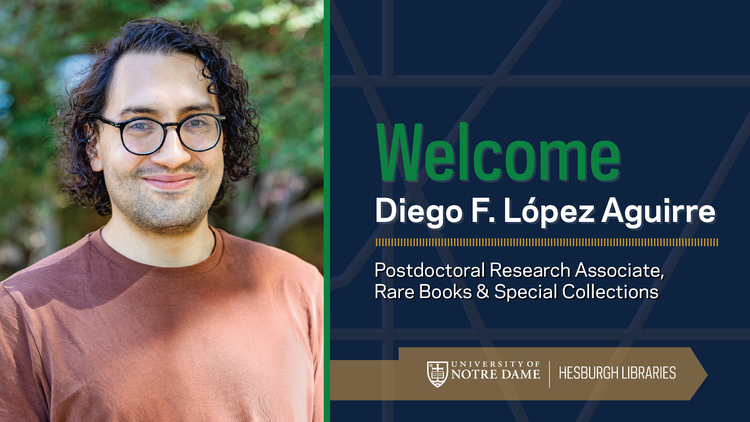
Diego F. López Aguirre, Ph.D., joined the Hesburgh Libraries in September as a postdoctoral research associate. His work will include collections-based instructional activities in Rare Books & Special Collections, as well as a semester-long collaboration with Professor Vanesa Miseres from the Department of Romance Languages and Literatures. He will also work to support the ongoing development and stewardship of the Hesburgh Libraries' Latin American, Iberian, and Latinx studies collections.
López Aguirre received his Ph.D. in Spanish from the University of Notre Dame in the spring of 2026.
Before coming to the United States, I worked for four and a half years at the Museo Colonial and the Museo Santa Clara (Bogotá D.C., Colombia), two public museums run by the Colombian Ministry of Culture. There, I learned about cultural heritage, preservation, management, collections, acquisitions, and public communication—all skills that have shaped both my professional and academic careers. I believe that the postdoctoral position offers me a chance to continue exploring this professional aspect of my life by learning how an American library research institution operates.
I will be working with Payton Phillips Quintanilla on cataloging, research, exhibitions, acquisitions, and other teaching projects for the Latin American, Iberian, and Latinx collections. For example, in the fall semester, I will be assisting Professor Vanesa Misere with a book art project for her class, “From Food to Table.” In class, students are exploring our historical cookbooks from Latin America to create their own. I’m in charge of working with the students when they visit Rare Books & Special Collections. I’m also working on organizing the backlog and transcribing unique manuscripts from the Durand collection (José E. Durand Peruvian History Collection), such as the Tragicomedia Ystoria de Joseph, a Peruvian manuscript theater play that we are aware of has only one copy in the world and is here at the Hesburgh Libraries.
One of the reasons I applied for my Ph.D. at ND was the incredible materials in my area of specialization, the Early Modern Spanish-American world. The Library, the Raclin Murphy Museum, and programs such as Romance Languages and Literatures, History, and Art History had faculty and collections that have influenced my own research. It is a unique opportunity to work with materials that are unknown and have much to offer the ND and outside communities. I’m also happy to see and understand how the Library's different departments work together.
Has anything about the Libraries surprised you now that you’re seeing how things work from the other side—as a colleague rather than a student?
I now have a different understanding of how I use the collections, how to relate to colleagues and former students who are now patrons, and other daily aspects of using the Library for research. I have also been surprised by the number of people working on different projects and aspects of library use. As a student and a user, you don’t realize how many people it takes to make the Library function. It has been nice to have a new type of relationship with staff whom I have known from past years.
