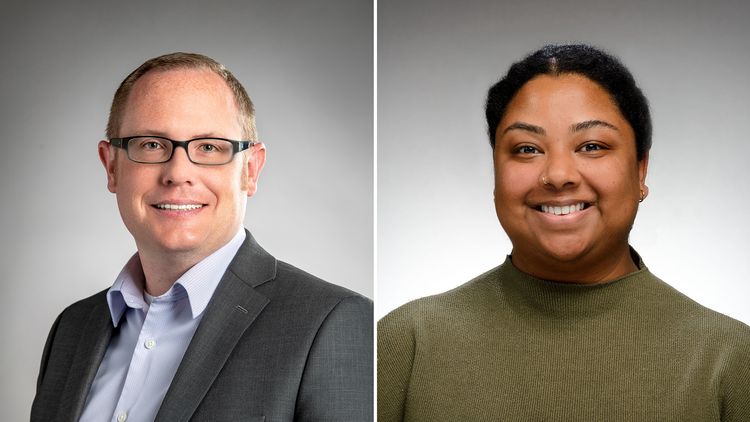
The Hesburgh Libraries welcomed two new faculty members during the fall of 2026, bringing expertise to the Navari Family Center for Digital Scholarship and the Preservation Department.
Brian Fogarty joined the Libraries in July as the economics and digital social sciences librarian, and Brittany Murray began her role as special collections conservator on September 1.
"We are so fortunate to have Brian and Brittany joining us this fall," said Margaret Meserve, Edward H. Arnold Dean of the Hesburgh Libraries. "Brian brings a wealth of experience in data analysis and support for quantitative social science research across disciplines and departments at Notre Dame. His arrival strengthens an already strong team in the Navari Center. Brittany is an outstanding early-career conservator who joins the Preservation Department at a critical moment, as interest in our special collections continues to grow. I look forward to the contributions both our new colleagues will make to the Libraries and to the campus community as a whole."

Through the Navari Center, Fogarty will serve as the primary liaison to the Department of Economics while supporting data-driven research across the University of Notre Dame. He is responsible for consultation and instruction on finding, managing, analyzing, and visualizing data, as well as using tools such as Stata, R, and Python. In addition, he collaborates with faculty, students, and campus partners on research and digital scholarship projects.
Prior to joining the Libraries, Fogarty served as an associate professor of the practice in the Lucy Family Institute for Data and Society and as a concurrent Associate Professor of the Practice in the Department of Political Science at the University of Notre Dame. He has also served as the Director of the Center for Social Science Research and an Associate Director of the Lucy Family Institute. He has also previously held positions at the University of Glasgow and the University of Missouri-St. Louis.
Fogarty holds a Ph.D. and a master’s degree in political science from the University of North Carolina.
Since beginning at Notre Dame in 2019, I have been aware of the excellent work being done at the Navari Center. In my previous positions, I frequently collaborated with the Navari Center on research consultations and training workshops, which gave me a strong appreciation for the expertise and support that the Hesburgh Libraries provides to researchers and students across the University. Those experiences gave me a firsthand understanding of the Libraries as a place where people from different disciplines and methodological traditions come together to advance research and teaching.
The Economics and Digital Social Sciences Librarian position felt like a natural next step in my career. My professional interests and experience have increasingly moved beyond a single discipline toward broad quantitative and computational social science, with an emphasis on research consultation, data analysis, instruction, and interdisciplinary collaboration. The position’s combination of serving the Department of Economics, contributing to the Navari Center, and helping researchers and students across the University use data and computational methods aligns especially well with both my professional background and the direction my career has taken.
My research examines how information environments shape political attitudes, behavior, and perceptions of democratic legitimacy. Much of my recent work focuses on misperceptions about elections and democratic processes, including testing interventions to correct false beliefs about elections. My colleagues and I are also developing survey-embedded AI tools that dynamically generate tailored corrective information about election procedures and institutional rules. As a faculty member in Hesburgh Libraries, I expect this research agenda to continue while also expanding into broader questions about how people encounter, evaluate, and use information in an increasingly complex digital environment.
I am particularly excited about the opportunity to collaborate with faculty and staff across Hesburgh Libraries and Notre Dame on questions that extend beyond the boundaries of any single discipline. The Libraries are uniquely positioned at the intersection of information, technology, teaching, and research, and I see substantial opportunities to explore how individuals evaluate information, how knowledge is created and shared, and how institutions adapt to new communication technologies. Notre Dame’s outstanding research resources and infrastructure, together with its growing investment in data, artificial intelligence, and computation, provide an exceptional environment for this work. I hope to use those resources not only to advance my own research but also to develop collaborations that generate new insights into some of the most pressing challenges facing our information environment.
What I am most looking forward to is becoming part of the Hesburgh Libraries community and learning from colleagues whose expertise spans such a broad range of disciplines, methods, and approaches to scholarship. Throughout my career at Notre Dame, I have valued opportunities to work across disciplinary boundaries, and I am excited to be in an environment where such collaboration is central to the mission. I am also looking forward to strengthening the relationship between the Hesburgh Libraries and the Department of Economics, while building connections with researchers and students across the University who are engaged in data-intensive and digital scholarship.
More broadly, I am excited about the opportunity to help build a vibrant digital scholarship community that reflects what is distinctive about Notre Dame. I am also particularly interested in leveraging the Libraries’ expertise in communicating scholarship beyond traditional academic audiences to make research more accessible and meaningful to broader communities. I look forward to continuing to contribute to the University while taking on a role that allows me to engage with the broader intellectual community in new ways.
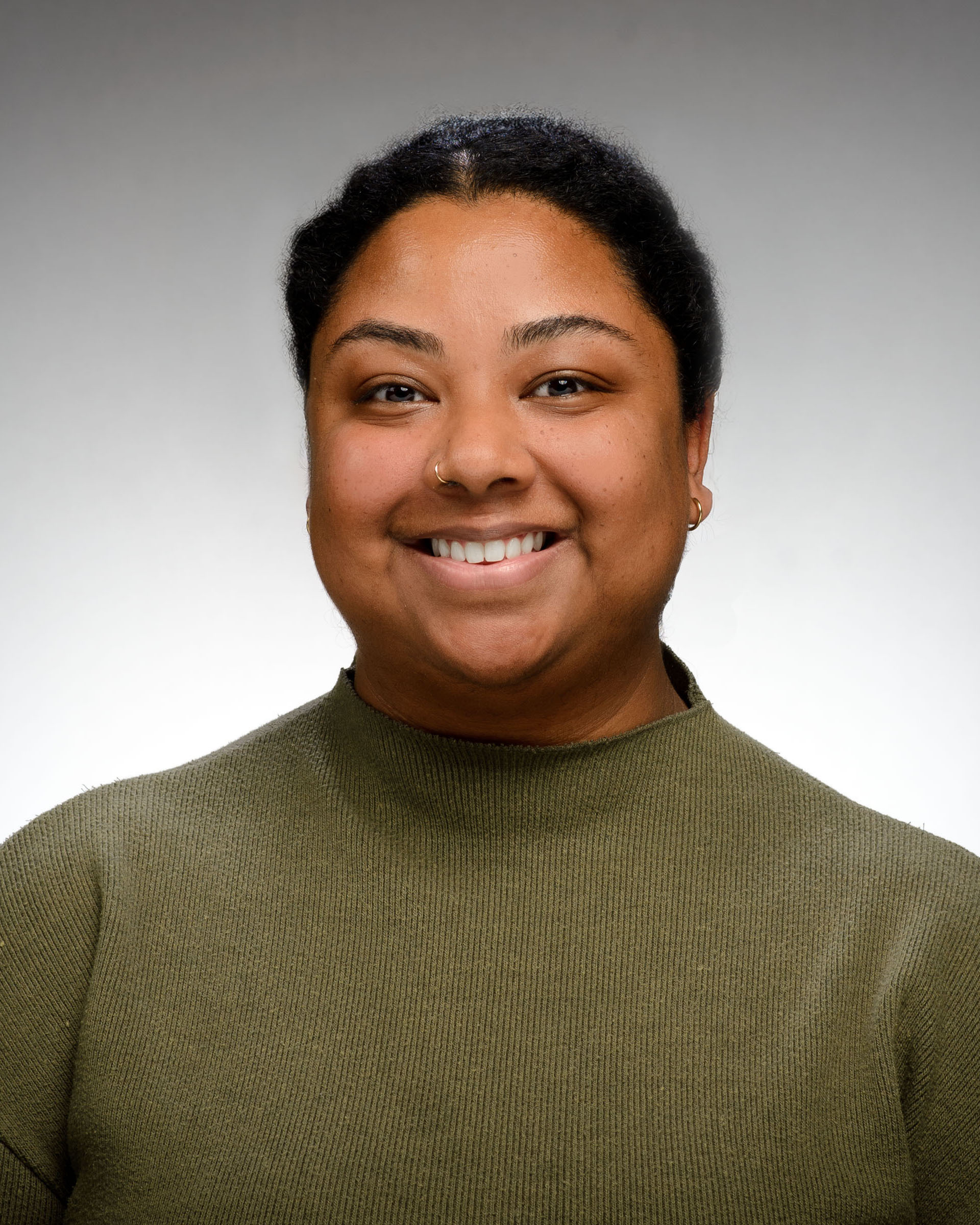
In the Preservation Department, Murray will play a vital role in ensuring the accessibility and preservation of the collections in Rare Books & Special Collections and the University Archives. She will execute conservation treatments and stabilize materials in the collection for current and future use by faculty, students, and researchers.
Murray previously served as the Charlottesville and Virginia collections conservator at the University of Virginia. She holds a master’s degree in art conservation from the Winterthur Program at the University of Delaware.
What drew me to the Hesburgh Libraries and my position as Special Collections Conservator was the impressive collection of rare books and manuscripts, and an equally impressive Preservation Department. Preservation maintains both circulating and special collections, allowing library materials to be studied and enjoyed, ideally in perpetuity. As a library and archive conservator, I get to examine, research, and repair rare and unique items in collections in preparation for teaching, digitization, research, and exhibition. I find my work incredibly fulfilling, and I am excited to contribute my skills and knowledge to the care of the Hesburgh collections.
My past research focused on the use of lead-based watercolor paints in early-20th-century children’s coloring books. My research interests are largely treatment-based, and I am waiting for the right item to land on my bench. I am sure I will have no trouble finding something that piques my interest in the Libraries’ vast collections.
Beyond working with collections, I am most looking forward to getting to know my colleagues, working with students, and finding new research opportunities. I am also looking forward to exploring South Bend and the surrounding area and getting to know members of the community.
